
By Martina Hubl, CAFLA Communications Coordinator
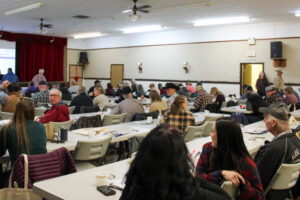 The 22nd annual Clearwater County Cattlemen’s Day drew a full house to the Leslieville Community Hall on November 20, where producers, industry experts and local organizations gathered for a day packed with presentations, networking and industry updates. A full tradeshow and a robust agenda set the tone for what proved to be one of the event’s strongest years.
The morning opened with brief remarks from event sponsors, including the Rocky Agricultural Society, ATB Financial, Corteva, Boehringer-Ingelheim, Envu, the Alberta Grazing Lease Holders Association, Trouw Nutrition, All Flex, CAFLA and Rocky Credit Union. Representatives highlighted ongoing initiatives and contributions to the agricultural sector.
The first keynote of the day was delivered by Dr. Alessa Kuczewski, who presented the Madigan Squeeze technique—a method originally developed by Dr. John Madigan for foals and now used effectively on newborn calves. The technique involves applying controlled pressure around a calf’s neck and chest for approximately 20 minutes to simulate the compression of the birth canal and “reset” the calf’s nervous system.
Dr. Kuczewski outlined situations in which the technique is most useful: calves under 24 hours old that appear weak, wander aimlessly, stand without purpose or show no desire to nurse—symptoms often described as “weak calf syndrome.” She also emphasized cases where the method is less effective, including calves older than 24 hours, oxygen-deprived calves and those with potential injuries such as broken ribs. She stressed the importance of assessing calves for injuries before attempting the procedure. 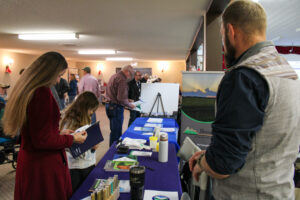
Next, Dr. Tim Nickel addressed cattle parasites, offering an overview of concerns in the region. He noted that two species of liver flukes have been documented in Alberta, typically detected post-mortem but occasionally observed through fecal flotation examination. He also discussed both sucking and chewing lice, explaining their differing life cycles and the importance of treating animals between November and February for optimal control. Lice can be seen with the naked eye, particularly around the face, chest and back.
Dr. Nickel also covered fly management, explaining that horn flies become problematic past the threshold of 200 flies per animal. He recommended rotational grazing and pasture harrowing every two to three months during grazing season to help break parasite cycles. Horn flies survive overwinter beneath manure, while face flies survive overwinter in buildings and are known to spread pinkeye.
Jenelle Smith of Trouw Nutrition followed with her presentation, Don’t Make Hay While the Sun Shines, comparing dry baling to silage production. She outlined the benefits of dry hay—including ease of storage and transport—and contrasted these with the higher nutrient retention and fermentation-based preservation offered by silage. Smith detailed the fermentation process, moisture levels and storage considerations required for successful silage production.
Norm Dueck of A&L Labs then discussed feed analysis, explaining the value of testing forage and adjusting rations accordingly. Attendees reviewed sample lab reports as Dueck guided them through interpreting key results and understanding how to collect accurate samples.
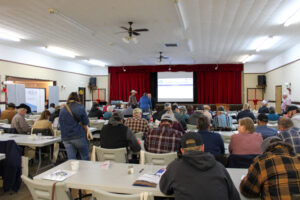 Market insights were provided by Brenna Grant, who offered an update on cattle prices and Canada’s current heifer retention trends, giving producers a clearer outlook on economic expectations heading into the coming months.
To conclude the event, Emma Cross of the Do More Ag Foundation delivered a presentation about Resilient Minds, underscoring the importance of mental health and self-care in agriculture. Her talk highlighted available resources and encouraged producers to focus on community support and personal well-being.
With a great turnout and plenty of useful advice shared, this year’s Cattlemen’s Day proved once again why it’s such an important event for Clearwater County’s livestock community.