
By Abby-Ann Redman, Alberta Pasture Nutrient Analysis Project
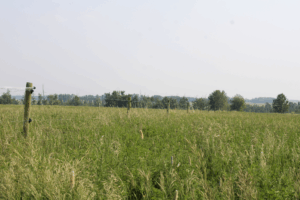 Over the past few years, I’ve had the opportunity to work on a project that digs deep into the nutrient quality of Alberta’s pastures. Alongside a fantastic team, I helped sample and analyze grasses from across the province to better understand how forage quality shifts throughout the grazing season and between regions.
If you’re a producer in Red Deer, Rocky Mountain House, or Caroline, this summary is for you. These areas were key regions in our study, and I want to share some practical takeaways from what we learned.
Energy: It Starts Strong, Then Drops Off
In early May, total digestible nutrients looked great. Both Red Deer and Rocky Mountain House pastures tested around 65%, which is more than enough to meet the needs of mid-gestation cows.
But by August, TDN dropped to about 59–60%, and by October, it dipped further: 55.9% in Red Deer and 57.3% in RMH. While this isn’t alarming, it’s right on the edge of what beef cows need. If you’re grazing late into the fall, keep in mind that your cows might not be getting enough energy from pasture alone.
Protein: Mostly Adequate, But Keep an Eye on It
We saw a similar seasonal pattern with crude protein. In May, both regions averaged over 15%, plenty to support reproduction and growth. Unsurprisingly, levels declined through summer and fall, landing at about 10–11% in October. That’s still above the 7–8% minimum requirement for mature cows, but it doesn’t leave much room for error. If forage is limited or weather poor, a protein boost might be needed to keep cattle in good condition.
Fibre: Higher as the Season Progresses
Neutral detergent fibre (NDF) gives us a sense of how “chewy” or fibrous the forage is. As plants mature, fibre increases and digestibility decreases. In May, NDF was under 51% in both regions. By October, it climbed to 56–58%. That’s not unusual, but it does mean cattle may consume less forage, especially since TDN is also low.
So, while the pasture might have abundant grass (quantity), the quality might not be keeping up with animal needs.
Calcium and Magnesium: Strong Showings
A nice surprise in the data? Calcium levels increased as the season went on, rising from 0.39–0.42% in May to 0.57–0.60% by October. That’s well above the 0.18–0.31% requirement for cows, thanks in part to tame grasses and legumes like alfalfa that are common in this area.
Magnesium was also solid, hovering above 0.14% throughout the season. That’s good news for minimizing risks like grass tetany.
Phosphorus: The One to Watch
Here’s where it gets tricky. In May, phosphorus levels were solid (0.26–0.29%), but by October, they had dropped to 0.13% in Red Deer and 0.15% in RMH. Since 0.14% is the bare minimum for mid-gestation cows, many pastures in this region are falling short by fall. Phosphorus deficiency can impact reproductive performance and overall herd health. A mineral program with added phosphorus for late-season grazing is a smart investment.
Potassium: Drops Over Time, Still Adequate
We saw the usual seasonal decline in potassium, from over 2.4% in the spring to around 1.0% in October. That’s still well above the 0.6–0.7% requirement, but it’s getting tighter. If you’re feeding poorer hay or experiencing drought, this could become a limiting nutrient.
Trace minerals: Small Requirement, Big Impact
Trace minerals include copper, zinc, manganese, and selenium, to name a few. These minerals were found to be deficient, or borderline, in every pasture tested, at all timepoints. We know these minerals are highly susceptible to antagonism which can worsen a deficiency. Rocky Mountain House was found to be one of the areas most susceptible to antagonism due to high molybdenum in the area. Feeding trace minerals throughout the entire grazing period was found to be essential.
Final Thoughts
Pasture quality in this area starts strong in the spring, but by fall, it takes a noticeable dip, especially for energy and phosphorus. For producers in Red Deer, Rocky Mountain House, and Caroline, late-season supplementation isn’t just a good idea, it might be essential, depending on your herd’s condition, stage of production, and your grazing strategy.
The full report is available here. https://cafla-ab.ca/projects/