
By Martina Hubl, CAFLA Communications Coordinator
The Central Alberta Forage and Livestock Association (CAFLA) welcomed local producers to its Hay! Let’s Talk Storage event on November 28 at the Hillside Community Hall in the County of Wetaskiwin.
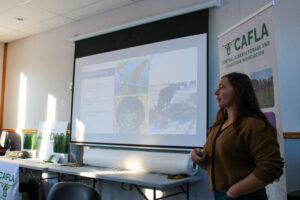 Attendees were welcomed with lunch from Huckleberry’s before settling in for an afternoon of learning. Reid Caukill of CAFLA opened the program with an overview of the Biodegradable Net Wrap Project. The project is funded by RDAR with the cooperation of local producer, Alana Schamber of Tin Forest Farm.
Caukill explained that the Biodegradable Net Wrap Comparison Project is a multi-year, on-farm study designed to test an environmentally friendly alternative to traditional synthetic net wrap used in hay baling. The product—Nature’s Net Wrap—is produced from plant-based biopolymers rather than petroleum-based plastics. The project aims to assess the material’s effectiveness, longevity, and impact on forage quality under real-world farming conditions. More information on project goals and progress is available on CAFLA’s website. https://cafla-ab.ca/projects/
Keynote speaker John Bland of Barbeejay Supplies Ltd. delivered a detailed session on effective bale storage. Bland emphasized the importance of achieving the correct moisture level in bales for long-term preservation, noting the many variables involved. He cautioned against stacking bales too early, explaining that they must undergo a natural curing process. “It’s a fine line,” Bland explained. “Some people stack too early, especially the big squares, because they don’t want rain on them, but the bales get brown in the middle of the stacks that way.” 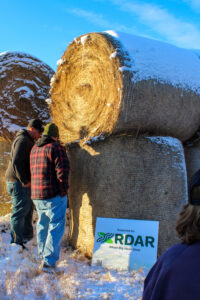
Bland also advised against storing bales on concrete, even inside a shed, noting that concrete can sweat. “In my opinion, mushroom is the worst stacking method,” Bland said, citing the way rain and snow can run off the top bale into the one below. He recommended storing bales in two single rows spaced about one foot apart on well-drained ground, with ends butted together to prevent freezing. While this method requires more space for handling, Bland maintained it yields the best results. By contrast, mushroom and pyramid stacks may save room but often result in browned, poor-quality feed at the center.
Abby-Ann Redman of Blue Rock Animal Nutrition followed with a session on interpreting feed test results. Redman outlined the principles behind proper sampling—a service currently offered by CAFLA—and provided an in-depth explanation of macronutrients, micronutrients, and mineral profiles. Sample slides, including general target-range guidelines for different livestock stages, are available on cafla-ab.ca.
After the presentations, producers travelled to nearby Tin Forest Farm, where Alana Schamber is hosting the County of Wetaskiwin site of the biodegradable net wrap project. The second project site is located in Lacombe County. 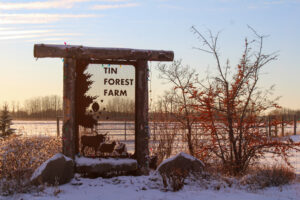
“It was nice to step away from the daily routine and connect with local farmers, hear about their operations, and learn from one another’s experiences.” ~Alana Schamber
Participants viewed the bale-stacking methods used in the study and had the opportunity to test the strength of the biodegradable net wrap at its current stage of decomposition. Those wishing to follow project updates or learn about future events are encouraged to visit cafla-ab.ca and consider becoming a member.