Canada Thistle Stem Mining Weevil Establishment Project
Background:
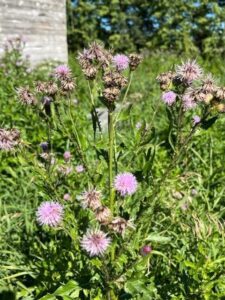
Canada Thistle is a highly invasive colonizing species. It is a Noxious weed listed under the Alberta Weed Control Act. Its ability to rapidly spread through lateral roots and seeds, gives this plant a major competitive advantage. This major agricultural invader has been challenging farmers and ranchers since the first contaminated seed was brought over with the early settlers. Farmers have been spraying, mowing, grazing and even burning thistle to try and control its spread. Many of the areas that Canada Thistle is becoming problematic are areas in which equipment, herbicides, and livestock cannot be used. Most often these areas are riparian transition zones, fence lines, and waste areas. There has been an increased interest in using alternative methods that are less environmentally impactful in part due to the cultural change in public view of weed control methods. Also, some of the areas are difficult to get equipment and people in to do the work.
*The use of alternative weed control then becomes the area of focus. Using insects as biocontrol agents for weed control has been an area of exploration for some time in various environments and parts of the world.
Why use insects for noxious weed control?
- Exotic (non-native) weeds can be invasive. Introduced foreign weeds came without the successful co-evolved enemies present in their native ranges. Without these natural checks, the weeds can out-compete native vegetation. Introducing biological control agents can help to restore the natural checks and balances that control exotic weeds in their native habitats.
- Biological controls are not a “quick fix”, but they are a permanent option for long-term management of invasive weeds.
- Biocontrols do not eliminate the invasive species, but instead work to control the abundance and to minimize the monoculture characteristic of infestations.
- The target weed will not be eradicated; instead, the objective is to reduce the population to the point that it becomes just another “well-behaved member” of the existing plant community.
- Biocontrol impacts the density and vigor of weeds, allowing native species to re-establish and more effectively compete.
- The beauty of biocontrol is that it is self-perpetuating. Once the insects are released, they continue to reproduce and spread on their own. Collect them yourself after establishment.
- Biocontrol insect populations will increase and spread to new areas on their own over time.
- Biological control is most effective when used for large infestations of invasive species; however, it can also be a viable option for smaller sites.
- Biocontrols are thoroughly researched before being certified and permitted, assuring that they will not attack crops or non-target species.
- With proper planning and management, biocontrol releases can be an important component of integrated weed control, working effectively with cultural, mechanical, and chemical controls.
- Biological weed control has been widely proven to be a cost-effective and viable weed control method, even for controlling widely dispersed and inaccessible invasive plant populations.
- the approach to weed control incorporates integrated pest management principles to provide biological control agents and related services for achieving maximum benefits economically.
The successful establishment of introduced insects depends upon biological and environmental conditions beyond our control.
However, we make no warranty about eventual establishment or degree of control obtained.
**The concept of classical biological control is very simple. Exotic (non-native) weeds are responsible for the vast majority of the range weed problems in North America. When foreign weeds are introduced, they come without the successful co-evolved enemies that are present in their native ranges. Without these natural checks present, the weeds are able to out-compete native vegetation.
Stem mining weevil Hadroplontus (formerly Ceutorhynchus) litura
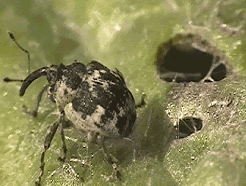
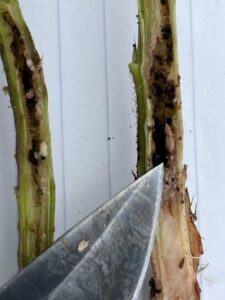
Hadroplontus Litura:
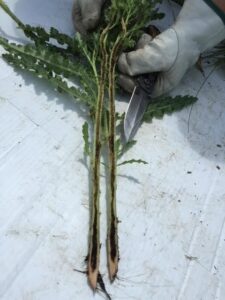
The larvae of this hardy weevil hatch on young leaf or stem tissue. They bore into the plant and mine towards the main stem. Older larvae mine the stem, crown, and root. The plant’s root reserves are reduced by an average of 50% in attacked plants. Canadian research showed that the incidence of a fatal rust fungus disease was more than doubled when the insect is present.
The Canada thistle stem mining weevil (Hadroplontus litura) occurs naturally in France, Switzerland, Austria, Germany, Britain, and southern Scandinavia. It was first introduced into Canada as a biological pest control agent in 1965. These agents have proven to be an effective method for control of Canada thistle.
The Thistle Stem Mining Weevil lives almost its entire life cycle on or in the Canada Thistle plant. It feeds, lays its eggs, and spends most of its juvenile larvae stage feeding within the stems and leaves of the plant. The only time its not on or in the Canada Thistle plant is during its juvenile to adult transformation stage and over wintering. Both of those times the weevil burrows beneath the surface of the soil at the base of the Canada Thistle plants.
Eggs are laid in the mid-vein of the rosette leaves in early spring and hatch after five to nine days. Larvae internally mine the inside of the stem of thistle plants as the shoot elongates during the summer. Fully developed larvae will exit the plant at the root and enter the soil to pupate. They will emerge again in their adult (weevil) form later in the summer and feed on thistle leaves before winter. Adults will over winter in the soil ready to lay their eggs and attack the emerging thistle the following spring.
Unfortunately, these tiny insects are unable to consume enough of the plant to actually destroy or prevent the plant from reproducing but do allow for control through secondary infections. The Weevils create access holes in the stems and leaves of the thistle when the larvae burrow through the plant. This allows bacteria and fungi to enter and infect the plant. This secondary infection stresses the plant and if conditions are right, destroys the plant and the weevils will slowly gain control over the colony.
The use of Thistle Stem Mining Weevils is not a fast-acting control method. It takes several years to establish a population. However, using these weevils in environmentally sensitive areas where herbicides, mowing, and grazing cannot be facilitated, these biological control agents can establish a population and eventually reduce the size of a thistle colony. They have no adverse effects to any other insect or plant species. They predominantly feed on Canada Thistle, although have been known to feed on a few other thistle species but will not become invasive and consume native or other beneficial plant species.
Goals:
The goals of this project are to:
- Establish populations of Canada Thistle Stem Mining Weevil in riparian or other environmentally sensitive areas where the use of herbicides, mowing, and grazing cannot occur to control Canada Thistle.
- Determine how many Weevils need to be released in order to establish a population, within an acceptable period of time, given a thistle colony density.
- Determine the length of time it takes a test population of weevils to become established and begin reducing the thistle colony of known plant density.
Protocol and Plan Execution:
Grey Wooded Forage Association conducted a basic study on the amount of time it takes to develop an established population of Thistle Stem Mining Weevils. In order to quantify this, we used four different test locations/areas of approximately 4m x 4m or 16m2. The Canada Thistle plant density should be consistent between all four locations. A minimum density was not required, however there was a severe enough infestation that it is having a negative impact on the surrounding beneficial vegetation. Each of the sites/replications attempted to be in a similar riparian ecosystem/landscape to rule out abiotic habitat differences. All the sites were intended to be free from livestock grazing. If livestock are present a fence needs to be installed around the perimeter of the test site. Wild animal disturbances need to be considered but preventing wildlife from entering the test location is not imperative.
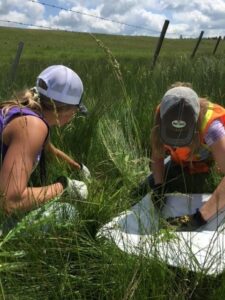
Each of the locations had an initial plant stand count of the thistle population done at random, however, the sampling locations within the test site were marked with a stake so future plant stand counts could occur at those same locations. There was a minimum of 5 counts taken using a quarter meter square ring to determine an average thistle population across the test area before the insect release. The thistle stand counts could then be compared across all four test locations to ensure uniformity of the test sites and for future comparison of stand reduction.
The adult weevils were released in September in the center of the defined test area. The first location is a check site where no weevils will be released. This site will be left as undisturbed as possible to compare the three treatment sites to it. Sites two, three, and four had weevils released. Site location two had one cup containing 105 weevils released in the center of the study area. Site three had two cups released in the center of the test area each cup containing 105 weevils. Site four had three cups released in the center of the test area each cup containing 105 weevils.
Having three different release sites will allow us to determine how long after the time of release we begin to appreciate thistle control. Each of the sites was visually monitored throughout the growing season. To determine if thistle control or suppression was occurring there were annual Canada Thistle plant stand counts occurring at each location in August before the first frost. Each of the initial plant stand count sites within the test area were recounted. This establishment project ran five years to identify any suppression or stand reductions that may be occurring.
Since this is an establishment project there will be only a single release of Weevils at these sites.
The two Mountain View County Sites were established at:
- Mountain View County 1: Bergen site
- Mountain View County 2: office site
A third site was to be in Lacombe County in the Leedale area. However, due to some last-minute circumstances the intended site had to be abandoned. and alternate sites were required immediately. Due to the time sensitive nature of the release and perishability of the newly transported weevils, an alternate site had to be found immediately. With a modified version of the protocol, 2 locations were sourced near Gilby, Alberta area with the cooperation of the Medicine River Watershed Society (MRWS). These locations would have only a single release site each with the 3-cup release equivalent. One site was on the banks of the Medicine River, and the other on a nearby farmyard thistle patch away from a riparian area. The larvae and plant stand evaluations were scheduled and taken in the same manner as the others. The Lacombe County producers with the MRWS were:
- Lacombe County 1: Medicine River site
- Lacombe County 2: Gilby site
Data Collection:
Year one:
Set up of the establishment project, began with the site selection and the initial Canada Thistle plant stand counts, followed by the release of the Weevils in September.
Year two:
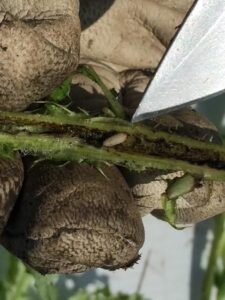
Visual assessment of the site and any adult weevils were documented. Thistle dissections took place, twenty thistle plants being dissected at random across the test location so larvae can be counted, and adult populations estimated to determine the survival the first winter. The dissections occurred in early July to ensure Weevil larvae are present. No plant stand count was necessary in year two since it is the first-year larvae are present.
Year three:
Visual assessment of adults present on site and any other observations noted. Thistle stem dissections occurred in July the same as year two with the stems taken at random across the test location. Plant stand counts follow up were taken in August to determine Canada Thistle suppression since year one release.
Year four and five:
The same process was followed as year three. It was imperative to leave the site as undisturbed as possible during the spring as this is when the adult weevils lay their eggs on the leaf of the Canada Thistle plant. Disturbing them causes the weevils to fall off the thistle plant and can prevent them from laying eggs. As a note, the check location also had visual assessments, plant stand counts, and thistle dissections completed to ensure there is no spread from the released populations.
Observations:
Study of the impact of stem mining weevils for biological control of Canada thistle was targeted in riparian areas. The survival, growth and spread of the weevils varied from site-to-site environments.
The project data collection was deferred during the 2020 Covid19 pandemic year due to the unprecedented public and social uncertainties surrounding external activities. The extension into 2022 allowed for final data collection and evaluation.
Results varied with locations attributed to the different positioning of the colonies relative to the high-water mark of the adjoining water courses. Flood prone sites appeared to have some weevil populations reduced.
The flood prone riparian areas had fluctuations in larvae/weevil impact with high water mark levels during spring runoff events, leading to possible impact of larvae viability due to excessive soil surface moisture. This is speculated as having waterlogged soils during the critical larvae stage below ground preventing effective activity to burrow into the lower thistle stem at the root level. This was particularly prevalent in the Nelson site on the banks of the Medicine River which frequently topped the banks in a spring runoff. The water logging potential was also present at the Mountain View County site, although high water mark reaching the site was not directly documented.
The Pregoda site was not a riparian area, rather a dense Canada Thistle patch in an undisturbed area. This site appeared to have the least amount of impact on larvae viability, although it did not demonstrate any recognizable off-site migration to adjoining thistle plants.
Griebel/Easterbrook site had one year of no grazing (2020) when sheep were dispersed but had 2021 and 2022 of high impact grazing with cattle. Livestock disturbance had a large negative impact on weevil populations and success. Interestingly, however, the Canada thistle control was greatest at this site indicating that the cattle were a greater bio control agent in this particular instance. The grazing stock density and timing would be attributed to the resultant Canada thistle decline.
In all of the sites it was observed that the very wet 2018 summer resulted in high numbers of Canada thistle damage and losses due to fungal diseases vs weevil damage. This is a phenomenon that is seen in very wet years being observed in many plant species from Canada thistle to poplar trees and annual crops (i.e., canola and field peas).
Conclusions:
The use of Canada thistle Stem Boring Weevils for biological weed control resulted in slightly positive to neutral Canada thistle plant control across the 4 sites. Although there appeared to be successful overwintering survival, there was little to no off-plot migration observed. This would lead to concluding that there was a negligible gain from migration. The overall Canada thistle control has been slow and erratic over the seasons and sites. Between “wet events” and other environmental influences we could not be consistent in predicting effectiveness of control.
- An additional aspect of the process is the relative cost and timeline invested to yield, in some cases, marginal results in the producer’s expectations. The cost effectiveness for intended control over a large area vs 3 x3 m sites is not attractive to many producers wanting to address large areas of Canada thistle infestations in a real setting. There is a place and time for use of bio control insects such as weevils, however, control expectations should be set lower than traditional alternate control methods.
- Canada thistles succumbing to natural pathogens due to the presence of weevil damage must be considered as an additional benefit to control outcomes. The niche environments with restricted options could still provide for the application of stem boring weevils. Emerging regenerative grazing and innovative agriculture practices are providing successful alternative opportunities for weed control in sensitive areas.
Acknowledgements:
The Grey Wooded Forage Association would like to acknowledge and extend our thanks to Mountain View County for its financial and site support for this project. The input and assistance from Lorelee Grattidge with our sample and data collection at the Mountain View County site is also much appreciated. We look forward to further collaboration with Mountain View County in future endeavors to the benefit of our mutual agricultural producers.
Projects of this nature are highly dependent on the cooperation and direct interest of the hosting producers. We are very grateful to the commitment, interest, and involvement of the cooperating producers for providing the sites for the Canada thistle Stem Mining Weevils over the duration of the project. It is our pleasure to recognize the cooperation of the producers involved with the respective sites in the Counties of Lacombe and Mountain View.