
The 2025 Ranching Opportunities Conference took place at the Pomeroy Inn and Suites this year on February 5th. The Red Bow Partnership consisting of the MD of Bighorn, Clearwater County, Kneehill County, Mountain View County, Rocky View County, Wheatland County, the Foothills Forage and Grazing Association, the Central Alberta Forage and Livestock Association, Lakeland College, Renovo Seed and Olds College hosted this well-attended event.
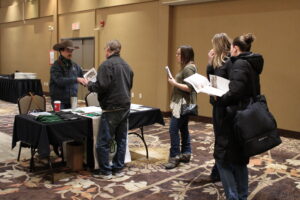 Producers attended various presentations regarding grazing and livestock beneficial management practices. To start the day, Dick Puurveen shared Lessons from the Breton Plots: Weather, Moisture, and Soil Management. Puurveen went on to explain the history of the Breton Plots and their cultural significance. Discussion about soil hydrology, weather, soil water retention, precipitation levels, forecast stations and statistics from past to future examples and data points gave producers historical context to the Breton Plots purpose.
Dr. Susan Markus, a research scientist for RDAR & Livestock Technology & Innovations at Lakeland College, gave an informative presentation on the topic of Beef Heifer Selection: Promising Technology for Data-Based Decision-Making. Discussion on using technology to determine when the replacement heifer was in their third cycle, as well as in relation to back fat and puberty timeline was considered. Results from studies such as Effect of Genetic Selection Pressure on Economically Important Traits were also shared where Dr. Markus recommends taking replacement heifers from the middle of the pack, as the study took many factors and scorings into account to determine which stock was the most profitable. Factors such as body scoring, maternal instinct and temperament were among those taken into account. Dr. Markus followed up with sharing research from the study Remote Assessment of Bull Breeding Activity on Pasture Using GPS.
To round out the morning, Mazen Aljarrah from Western Crop Innovations spoke about Why Triticale is the Ideal Feed and Forage Crop for Western Canada. Aljarrah went on to explain the benefits of triticale, bringing to attention the high yields, better digestibility and grain quality, as well as deeper roots and resulting stronger soils. Triticale is great for winter growing to benefit producers with early grazing.
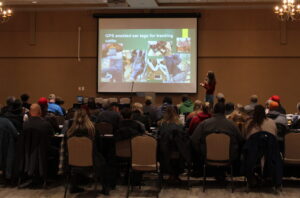 After a fantastic beef-on-a-bun lunch, producers got to choose two of three breakout sessions to attend. Christine Fulkerth of Olds College held a breakout session entitled Invasive Plants in Your Pasture. Highlighting the five pillars of integrated weed management: prevention, cultural, mechanical/physical, biological and chemical. Fulkerth also showcased the ‘dirty dozen’ found in Central Alberta. Forage Specialist Grant Lastiwka presented at the conference, sharing Tips and Tricks to Bale Grazing. Lastiwka shared personal stories and resources for producers considering starting bale grazing within their operation. Discussion surrounded the average weight of feed per animal and how different types of bales, twine and silage feed can be personalized for your needs. Lastiwka also shared that there are mentors and neighbours to ask your questions, implementing a beneficial management practice that is new to you doesn’t have to be on your own. In the south sheep barn at Olds College, Dr. Yaogeng Lei and John Shearer presented A Novel Auscultation Technology for Sheep Pregnancy and Litter Size Detection, where attendees learned more about new AI technology for animals.
To finish the conference, a producer panel assembled to present a collection of topics. Graydon Garner presented on flexibility of Winter Cereals in Livestock Production Systems, discussing how cows need 25% more nutrients after calving and the benefit of having this crop to supplement your cows in the spring can aid your operation. Garner also mentioned how OFCAF funding can be an option for your operation to achieve this benefit. Next, Brad and Terri Mappin spoke about their current project: Wyoming Snow Fences for Snow/Water Capture. The Mappins went on to discuss how their dugouts in the 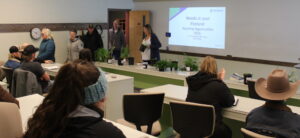 southern part of the province are primarily dry. The ongoing trial involves a Wyoming style snow fence constructed in 8ft or 12ft wooden structures and are placed about 150ft from their dugouts to capture snow and hopefully replenish with the spring runoff. Jim Bauer finished the panel with a presentation about the benefits of Stockpiled Pasture for Early Spring Grazing. Bauer explains the benefits of having long carryover grass under the snow, how it is a good insulator for the spring babies being born, and can replenish the fiber, energy and protein in the forage.
“It was a great day of learning, sharing struggles, and successes and making connections. There is so much science behind what ranchers and farmers do. I was blown away by the session on the new AI technology for animals and eventually for humans, too. The beef heifer and soil management selection were also my favorites yesterday.” Producer in attendance SherryAnn Hoogland said about the conference.