
By Martina Hubl, CAFLA Communications Coordinator
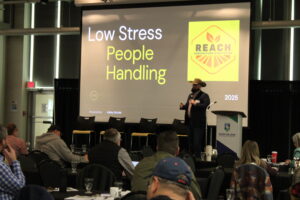 Producers from across the region gathered at the Olds College Alumni Centre on February 5 for Ranching Opportunities, an event hosted by the Red Bow Agriculture Society. Along with a full slate of speakers, attendees had the chance to visit a tradeshow running throughout the day.
Opening the event was Ashley Nicholls of REACH Agriculture Strategies with a presentation titled Low Stress Handling in People — What Our Livestock Can Teach Us About Effective Communication. Nicholls focused on the basics that often get overlooked: saying good morning, being aware of body language, and paying attention to tone of voice.
He shared a statistic that caught the room’s attention: 55 per cent of communication is body language, 38 per cent is tone and pitch of voice, and just 7 per cent is the actual words used. To drive home the point — and illustrate Newton’s Third Law, where every action has an equal and opposite reaction — Nicholls invited volunteers onstage for a pressure-and-release exercise. Each participant balanced a long wire with one finger and attempted to lower it to the ground without dropping it. Despite their efforts to move downward, the wire often rose instead, highlighting how communication and group dynamics can produce unintended results.
Nicholls also touched on personality types, referencing tools such as Meyers Briggs, and encouraged producers to consider comfort zones — both their own and those of their family members and crew. Understanding how people operate, he said, can improve communication on the farm just as much as it can in the pasture.
After a coffee break and time at the tradeshow, Brenna Grant of Canfax took the stage with a timely message: Don’t Waste Record High Profits — Setting Yourself Up for the Next Cattle Cycle. Grant outlined practical steps producers can take to make the most of strong markets.
Her advice began with knowing your numbers. Grant suggested allocating 60 per cent of profits back into the operation, 30 per cent toward working capital, and 10 per cent for personal enjoyment. However, she noted that costs have risen roughly 30 per cent since 2020, placing additional pressure on smaller operations.
Grant encouraged producers to take advantage of programs and research, including the record-keeping modules available through the Beef Cattle Research Council (BCRC). She also stressed the importance of understanding yardage costs and overall expense management. Other key themes included “getting better before you get bigger,” setting clear goals, remaining adaptable, investing in education and networks, and identifying the passion behind the operation — “knowing your why.”
The morning concluded with a presentation from Devon Knopp of Benalto Agri Services on How to Understand Your Soil Report. Knopp emphasized the value of soil sampling and explained how results can guide more informed decisions.
Understanding soil fertility and soil type, he noted, plays a major role in achieving accurate yields through crop rotation, determining fertilizer requirements, and optimizing grazing rotations.
Following lunch, and a brief presentation from the Red Bow Ag Committee announcing a donation to the Olds College Students’ Association Food Bank, Knopp returned to the stage for a more in-depth session titled Reading and Interpreting Your Soil Reports. Using a sample report from a Clearwater County producer, he walked attendees through where to find potassium, phosphorus, nitrogen, sulphur, organic matter and other key indicators, along with what ideal percentages and nutrient levels look like depending on land use.
Knopp also covered benchmark sampling, proper timing, and correct sampling methods. He reminded producers that many operations do not have balanced nutrients and strongly recommended regular soil testing. CAFLA offers a soil sampling service, with samples sent to the lab through the Benalto Agri Services office.
The afternoon wrapped up with the Food Water Wellness Foundation, where Kimberly Cornish presented a screening of From Principles to Practice: Living Systems in Action. The videos featured producers implementing innovative approaches on their own operations and were followed by a panel discussion with those same producers.
 After an introductory segment on soil mapping, Brendon Anderson, Gerald Vandervalk and Harold Perry shared insights into their farms and the projects they have been developing. Cornish explained that the series was producer-driven. Rather than requiring producers to travel for multi-day learning trips, many requested a video format they could watch from home.
“This is the farm I grew up on,” Brendon Anderson says in the panel discussion, “We just took what they were doing… you look at things a lot differently when you’re just coming into it versus at the end of your career.”
For first-time attendee Kurt M., the event delivered. When asked about his favourite part of the day, he said, “It’s my first time attending. The talk on soil sampling was at a professor level but broken down for producers. The Canfax presentation was really good as well.”
With practical takeaways, strong attendance and a steady flow of conversation throughout the tradeshow, Ranching Opportunities once again provided Central Alberta producers with tools, ideas and connections to bring back to their operations.