
Representatives from Alberta’s applied research and forage associations visited the Legislature to meet with the former Minister of Agriculture and Irrigation as well as the ministry staff to talk about the role agricultural extension continues to play across the province.
Extension is one of those terms commonly used in agriculture, but not always well understood outside the industry. Put simply, extension is about getting practical information into the hands of producers. It connects research and real-world farming by helping producers apply ideas, practices, and innovations in ways that make sense for their own operations.
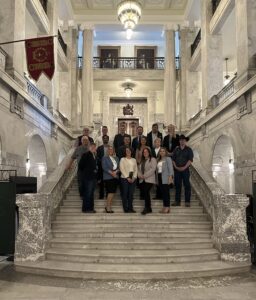
As Executive Director of the Central Alberta Forage and Livestock Association (CAFLA), I have seen firsthand how important that work is.
I am still fairly new to the agriculture industry compared to many of the producers and colleagues I work alongside. When I first entered the sector, the learning curve was significant. One of the things that stood out early on was how important extension organizations are in helping people navigate the amount of information that exists in agriculture today.
There is no shortage of research, opinions, or new ideas available to producers. The challenge is finding information that is practical, credible, and relevant to a specific region and operation.
That is where organizations like CAFLA and the broader Agriculture Research and Extension Council of Alberta network provide real value.
Research alone is not enough if it never leaves a report or research paper.
Most producers do not have time to dig through academic studies while managing weather, markets, input costs, livestock, equipment, and the day-to-day realities of running an operation. What they need is information they can trust and apply in practical ways.
Across Alberta, producer-led applied research associations help fill that gap through demonstrations, field days, pasture walks, workshops, trials, and educational events that bring research into a local context.
That local piece matters.
Agriculture is different across every region of Alberta. Conditions in the Peace Region are different from Central Alberta, and different again from the south. Applied research associations understand those differences because they are rooted in the communities they serve and guided by producer-led boards that identify local priorities.
That also creates trust.
Producers are far more likely to consider trying a new practice when they can see it working under conditions similar to their own. Often it is not a research paper that changes someone’s mind — it is a conversation at a field day or seeing results firsthand on a local site.
During our meeting at the Legislature, our delegation spoke about the collaborative work happening between applied research associations, producers, municipalities, government, post-secondary institutions, industry partners, and organizations like Results Driven Agriculture Research.
We also talked about the importance of maintaining strong regional extension capacity across rural Alberta.
A lot of this work happens quietly in community halls, research plots, pastures, classrooms, and farm shops across the province. It may not always attract attention, but it plays an important role in helping producers make informed decisions with confidence.
Coming into agriculture from outside the industry, the value of extension became clear to me very quickly. The more time I spend working with producers and applied research organizations, the more I appreciate the role these organizations play in keeping agriculture practical, connected, and grounded in the realities producers face every day.